
Camino Portugés coastal: A Guarda to Santiago
At some point, the Camino changes.
Perhaps you notice it when you cross the River Miño. Perhaps it happens when the Portuguese language slowly gives way to Galician and Spanish. Or perhaps you only realise it a few days later, when you look back and understand that the beginning of the journey feels surprisingly far away.
The second half of the Camino Portugués Coastal begins in Galicia, in the area of A Guarda, and continues along the coast through Oia, Baiona and Vigo before joining the Portuguese central at Redondela. From there, the route continues through Pontevedra, Caldas de Reis and Padrón before reaching Santiago de Compostela.
The landscape also begins to change. The wild Atlantic coastline is still present, but now there are dramatic viewpoints, historic monasteries, fishing towns, busy cities and increasingly familiar yellow arrows. You are getting closer, but somehow, that does not necessarily make the journey easier.
A Guarda: entering Galicia
A Guarda is the first important stop on the Galician section of the Coastal Camino. The town sits near the mouth of the River Miño and has a strong maritime identity. But one of the most impressive places to visit is Monte Santa Trega. The hill rises above the area and offers spectacular views across the Atlantic, the River Miño and Portugal.
It is also home to an important archaeological site with the remains of a pre-Roman settlement. Standing there, looking across the river, you can see the country you have just left behind. Portugal is still right there, but you are now walking through Galicia.
It is a beautiful moment to pause. I have to admint, on all caminos the Galician part is usually my favourite, it's the land of rain and cows (and witches according to the locals).
The Camino is full of these small transitions. Sometimes they are marked by a famous monument. Sometimes by a bridge or a yellow arrow. And sometimes, simply by the feeling that the landscape around you has changed.
The wild coast towards Oia
From A Guarda, the route continues northwards along one of the most beautiful sections of the Camino Portugués Coastal. The coast becomes more dramatic, the Atlantic feels stronger, the landscape is more open and wild.
This is a section where it is worth slowing down, not because you are tired, because you may not want to miss it.
The route towards Oia follows the coastline, and the small town is particularly famous for the Monastery of Santa María de Oia, a Cistercian monastery standing close to the sea. There is something unforgettable about seeing a historic monastery with the Atlantic as its backdrop.
It feels very Galician. Old stone, blue skies, green hills, the sound of waves, and the knowledge that people have been travelling through this landscape for centuries.
After As Marinas you will see a lighthouse, where the road turns. Officially the arrows lead you through a forest on the hill, but if you walk straight by the coast you can find a beautiful beach at the lighthouse which is full of colorful seaglass. If you like these types of adventures don't miss out on it and you can take a piece with you as memory.
Baiona: a perfect place to pause
Baiona is one of the places where many pilgrims are happy to arrive. It has a beautiful historic centre, a harbour and a lively seaside atmosphere. The town is also connected to one of the most famous events in European maritime history: in 1493, news of Christopher Columbus's arrival in the Americas reached Europe through Baiona. Whether you are interested in history or not, Baiona is simply a lovely place to spend an evening.
After a long day of walking, there is something particularly enjoyable about arriving in a coastal town where you can sit down, order a meal and watch the world go by.
The Camino can be physically demanding, but some of the best moments are not dramatic, they are the ordinary ones. A shower at the end of the walk, a clean T-shirt, a cold drink, a meal you didn't have to cook, and a bed waiting for you.
The road to Vigo
Leaving Baiona, the Camino continues towards Vigo. This is one of the sections where the route can become more urban and varied. There are still beautiful coastal views, but you may also walk through more developed areas and encounter climbs and descents.
Vigo itself is a major city and one of the largest urban areas in Galicia. For some pilgrims, arriving in Vigo is a welcome change. There are plenty of shops, cafés, restaurants and services. For others, the city can feel like a contrast to the quieter coastal sections. Personally, I think both experiences are part of the Camino, the route is not designed to give you beautiful scenery every minute of every day. Some days are beaches, some days are forests, some days are city streets, some days are simply a long road that seems to continue forever.
And sometimes, the less beautiful sections teach you the most about patience. Vigo was not my favourite, after the peace and quiet it can feel very big and busy, but rented an apartment for myself to have a good night sleep. It was a great decision as Galicia welcomed me with puring rain all day. I planned to have a short day and arrive around noon, but met a lovely American lady and had a slow walk and a great chat with her. But this is the true essence of the camino, you never know what waits for you that day, just accept it and go with the flow.
If you have the time and energy go up and visit the fort on the hill, it has got awesome views to the ocean and the city.
Vigo to Redondela: the camino starts to feel different
From Vigo, the route continues towards Redondela. This is an important point because the Coastal Way joins the Portuguese Central Way here. You may notice a change in the number of pilgrims, the camino can start to feel busier. There may be more people walking in front of you and more pilgrims arriving at the same cafés and accommodation.
For some people, this is exciting, for others, it takes a little getting used to.
The route between Vigo and Redondela can include more challenging climbs and descents, depending on the variant you follow. The coastal and inland options can differ, so checking your exact route before setting off is useful.
And this is where one of the most important Camino lessons appears again: don't assume that a shorter distance automatically means an easier day. A 16-kilometre day with steep climbs may feel much harder than a 25-kilometre day on a flatter route. Look at the terrain, not only the kilometres.
Tip: the Gronze site is very good place to check this, under the map you will find a + sign, if you click on it you can see the elevations for each sections and plan accordingly.
Redondela to Pontevedra
Once you leave Redondela, the Camino begins to feel more like the traditional Portuguese route. The landscape becomes greener and more rural, there are forests, small villages, stone paths and beautiful stretches of countryside. The route towards Pontevedra is one of those days where you may find yourself falling into the rhythm of the Camino again: left foot, right foot, yellow arrow, a small café, another kilometre, then another.
Pontevedra is one of the most beautiful cities on this part of the route. Its historic centre is perfect for wandering around, and it is a wonderful place to slow down for an evening.
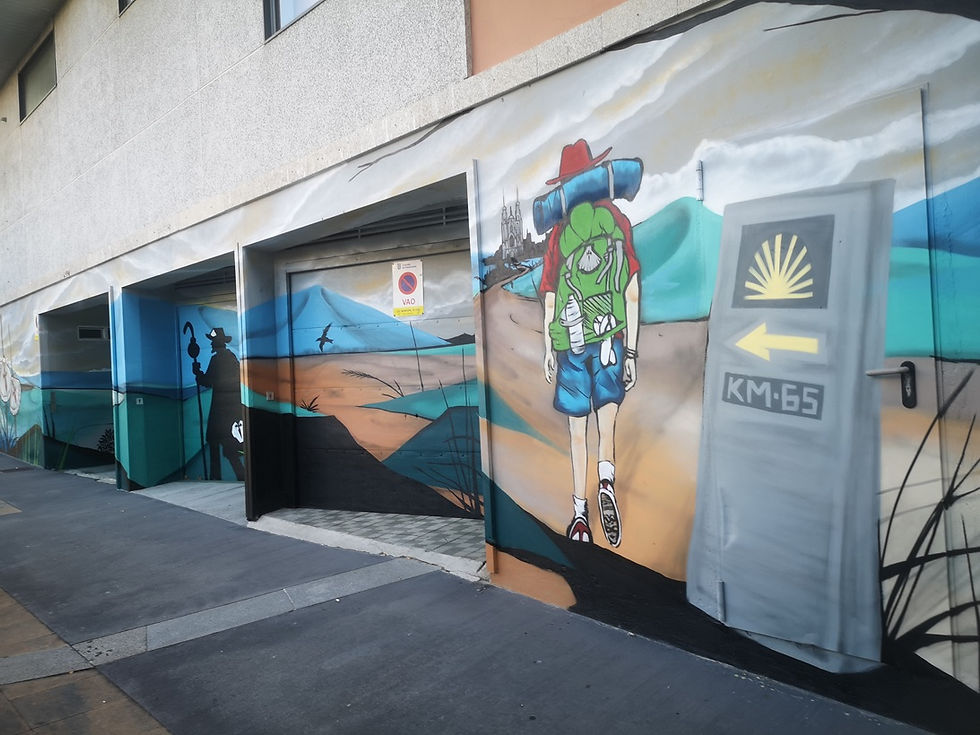
If you have the time, I would recommend exploring the city rather than simply treating it as another overnight stop. You will find cute little shops in the narrow streets, beautiful old churches (Convento de San Francisco, Ruínas de Santo Domingos, Basilica de Santa María), tiny bars and restaurants. You will leave the city next morning through the Ponte do Burgo, which is an older bridge made of stone, and in contrast you will see the Puente de los Tirantes, a quite modern bridge on your right.
Pontevedra to Caldas de Reis
After Pontevedra, the route continues through a mixture of rural landscapes, small villages and forest paths towards Caldas de Reis. This section is generally a pleasant walking day, but your experience will depend on the weather, your stage length and how your body is feeling by this point in the journey. By now, your feet may have opinions of their own, listen to them.
If you feel a hot spot developing, deal with it early. A small problem can become a very painful problem after another 10 kilometres.
Tip: after a few kilometres from Pontevedra you have to make a decision weather to follow the central way up to Santiago, or join the Espiritual Variante heading back to the coast. Both sections have their unique athmosphere, so it's a hard decision. In this blog post we stay on the central, but you can read about the Espiritual Variante in an upcoming one.
On the way to Caldas de Reis you will pass Fervenzas do Barosa. It is indicated on the camino with a sign, but the route doesn't go through this place. I highly recommend taking the detour, about 200 meters more and you will find yourself at a huge waterfall in a forested area with possibility to relax and eat at the bar. You will find signs leading back on the camino from there.
Caldas de Reis is known for its thermal waters and has long been associated with bathing and relaxation. For many pilgrims, this makes it a particularly welcome stop.
There is something wonderful about reaching a town after a long day of walking and knowing that your evening can involve doing absolutely nothing, and doing nothing is sometimes exactly what your body needs.
Tip: you will find some places with water, which were used for doing laundry back in time, but now they are filled with thermal water, where you can sit on the side and put your feet in the water to relax.
If you still feel the energy to walk a bit more 2 kms from the city centre you will find Fervenza de Segade, a huge waterfall, where you can sit on the rocks and admire the power of the water.
Caldas de Reis to Padrón
The route continues through green Galician countryside towards Padrón. This is one of the sections where the landscape can feel especially peaceful. You may walk through forests and rural areas, passing small villages and traditional buildings along the way.
Padrón itself is an important place in the story of Santiago. According to tradition, the boat carrying the remains of Saint James arrived in this area. The town is also famous for its small green peppers, the famous pimientos de Padrón. And yes, if you see them on a menu, you may want to try them.
Tip: Padrón has it's own city compostela, which you can get at the Tourist office (on the right corner of the big parking lot you will walk in). I recommend to check opening times, because are not opened all day, it's also a small library. The compostela costs 2 euros (in 2026).

The final walk to Santiago
And then comes the final day, Padrón to Santiago. The distance is around 24 kilometres in one commonly used itinerary, although exact distances depend on your route and stage planning.
At the beginning of the day, Santiago may feel far away. Then the signs begin to appear, you will start to count the remaining kilometers. The landscape gradually changes, you see more pilgrims, you start recognising the feeling, you are close. From the hills of O Milladorio you can already see the towers of the cathedral in the distance.
And then, after all those mornings of putting on your shoes, all those hills, all those cafés, all those moments of wondering whether you still have enough energy to continue, you arrive to Santiago de Compostela.
The cathedral, the old city, the famous square with the people who have just finished walking, and some people who are about to begin. And you.
For a moment, it can be difficult to understand that it is over, especially if it's your first time.
The Camino has occupied your entire day for so long: wake up, walk, eat, find accommodation, wash clothes, sleep, repeat.
And suddenly, there is no arrow telling you where to go next. But perhaps that is the final lesson.The Camino ends in Santiago, the journey does not.
Useful tips for the second half of the Camino Portugués Coastal
Check your route around Vigo carefully. The Coastal Way can offer different options, and the route through the city and surrounding areas may involve more climbing than expected. Apps like gronze or Camino Ninja can help find your way.
Take time in A Guarda, Baiona and Pontevedra. These are not simply places to sleep. They are some of the cultural highlights of the route.
Don't underestimate Galicia's hills. The Camino may be called Coastal, but that does not mean it is completely flat.
Keep your daily distances realistic. A shorter day can be a good idea when you want to explore a town or simply give your body time to recover.
Make the most of the food. Galicia has a wonderful food culture, and the Camino is a perfect excuse to enjoy local dishes along the way. Try the traditional tortilla and the Padron peppers if they are in season.
Don't wait until Santiago to celebrate. Every day you complete is part of the achievement. And when you finally reach the cathedral, don't rush away. Stand there for a while. Sit down in the square and look around. Think about where you started. The Camino Portugués Coastal is not only about walking beside the ocean. It is about moving through different landscapes, countries, towns and versions of yourself. You begin in Porto with a route in front of you, you finish in Santiago with a story behind you.
And somewhere between the first yellow arrow and the last step into the square, you realise that the Camino was never only about reaching the destination. It was about everything that happened while you were walking, the changes that began forming inside you.
Buen Camino.
Hope these tips get you in the mood for your next adventure, and you found some useful information. If you still need more details or build up confidence and courage for the planning and start of your journey, don't hesitate to contact me or email me, I'm happy to help.
You can also find me on social media with more useful advice and travel pictures at @wander.with.dora name. Contact me for a free call on wanderwithdora@gmail.com
Safe travels everyone. Buen camino!


Comments